

Prof. Ritu Agarwal, PhD is Professor and the Robert H. Smith Dean’s Chair of Information Systems at the Robert H. Smith School of Business, University of Maryland, College Park. She is also the founder and director of the Center for Health Information and Decision Systems. Dr. Agarwal has published over 90 papers in leading academic journals such as Information Systems Research, MIS Quarterly, and Management Science, and is a frequent speaker at national and international conferences. In 2019, she received the LEO Award of the Association for Information Systems (AIS). Her current research is focused on the digital transformation of healthcare, use of IT in clinical routines, health informatics, digital information privacy, and the role of technology in patient engagement.
The Digital Transformation of Healthcare: Technology-Mediated Mobile Social Engagement (MOSE) for the Management of Chronic Disease
As mobile devices become more integrated into daily lives and routines, they represent a striking opportunity for enhancing individual’s engagement with health management and wellness and reducing healthcare costs. Professor Agarwal’s research will investigate how social interactions with peers and healthcare professionals on a technology mediated platform empower and motivate older patients to engage in self-management of diabetes, and the effects of such interactions on health outcomes. The project will advance the science of the design, implementation, and evaluation of mobile device-based social engagement (MOSE) apps that can improve the health and wellbeing of patients with chronic conditions.

Prof. Miguel F. Anjos, PhD is Chair of Operational Research at the University of Edinburgh, and an Inria International Chair. His expertise is in mathematical optimization, particularly for applications in electric energy systems. He is the Founding Academic Director of the Trottier Institute for Energy at Polytechnique Montreal and President-Elect of the INFORMS Section on Energy, Natural Resources, and the Environment. His accolades include IEEE Senior Membership, a Canada Research Chair, an NSERC-Hydro-Quebec-Schneider Electric Industrial Research Chair, a Humboldt Research Fellowship, the title of EUROPT Fellow, and the Queen Elizabeth II Diamond Jubilee Medal. He is a Fellow of the Canadian Academy of Engineering.
Large-Scale Integration of Prosumers Into Electricity Markets and Systems Operation
The transition to renewable energies requires a major rethinking of society’s electricity networks and markets. A key development is the emergence of technology-enabled small-scale prosumers (who both produce and consume electricity), as is already happening in Germany and the UK, among others. The integration of prosumers into the electric energy system in (very) large numbers gives rise to important technical and economic challenges.
This project will develop novel mathematical models for prosumers to optimize their energy generation and consumption, for the grid operator to optimize the integration of prosumers, and for aggregators to optimize their flexibility offer in the energy markets.

Originally a chemical engineer, Prof. John Bessant, PhD has been active in research and consultancy in technology and innovation management for over 25 years. He currently holds the Chair in Innovation and Entrepreneurship at Exeter University where he is also Associate Dean for Research and Knowledge Transfer.
In 2003 he was awarded a Fellowship with the Advanced Institute for Management Research and was also elected a Fellow of the British Academy of Management. He served on the Business and Management Panel of both the 2001 and 2008 Research Assessment Exercises and has acted as advisor to various national governments, companies and international bodies.
Innovation as Unusual
Innovation is essential for survival and growth – but exploiting its potential depends on our ability to organize and manage the process of change. Whilst we know a lot about how to do this under what can be called “steady state” conditions we still have much to learn about dealing with the challenge of discontinuity. When new technologies arrive, when new markets emerge, when surprising events shake the foundations of our normal world, we need new skills in enabling innovation.
John Bessant’s research will build on a shared learning process involving academics working alongside public and private sector organizations in a network of “innovation laboratories” trying to explore these challenges and develop tools to help meet them effectively.

Prof. Thomas L. Brewer is Professor Emeritus at the School of Business of Georgetown University in Washington, DC. His publications on climate change issues include five articles in the refereed journal, Climate Policy, as well as chapters in books published by Cambridge University and The Brookings Institution, Elsevier and Routledge. He is the symposium editor for a forthcoming special issue of the refereed journal The World Economy, on issues at the intersection of trade and climate change.
He has made presentations on climate change issues at conferences at the Brookings Institution in Washington, DC, the Royal Institute of International Affairs (Chatham House) in London, the Centre for European Policy Studies (CEPS) in Brussels, the Economic and Social Research Institute (ESRI) in Tokyo, the European Union Commission and Parliament, COP/MOP climate change conferences, and numerous other venues. He has also published articles on international trade and investment issues in refereed journals and in the Oxford Handbook of International Business.
He has been a consultant to the World Bank, the United Nations Conference on Trade and Development (UNCTAD), and the Organization for Economic Cooperation and Development (OECD). He is an Associate Fellow of the Centre for European Policy Studies in Brussels and US Special Advisor for Climate Strategies in Cambridge, UK.
International Trade and International Climate Change: Issues at the Intersection
This research has two principal focal topics: Firstly, international competitiveness issues posed by an international economic environment with different carbon prices emerging from different climate policies, including comparative research on the EU and the US. Secondly, international transfers of climate friendly technologies. This work includes the international trade, investment and technology transfer practices of multinational firms and the government policies that encourage or inhibit them.

Prof. David Burgstahler, PhD is Julius A. Roller Professor of Accounting at the University of Washington. Professor Burgstahler has been on the Foster School of Business faculty since 1981 and served as Associate Dean for Masters Programs from 2002-2004 and as Acting Dean from January to May 2005. He has also served as Vice-President for Publications of the American Accounting Association from 2007-2009. His research and teaching interests include earnings management, capital market reactions to earnings surprises, valuation, statistical methods in auditing, and research methods. He received the 2002 AAA-AICPA Notable Contributions to the Accounting Literature Award.
Size Management by European Private Firms to Minimize Disclosure and Audit Costs
David Burgstahler evaluates evidence of size management to avoid competitive costs of disclosure, as well as the cost of audits, for small, private firms in Europe. Disclosure and audit requirements are determined by firm size, as measured by total assets, sales, and number of employees. While there is substantial variation across jurisdictions, small firms are frequently not required to disclose a complete set of financial statements nor to have an audit. Thus, to the extent expanded financial statement disclosures and audits are costly, firms have incentives to manage their size to remain below the thresholds that impose audit and disclosure requirements.

Prof. Samir Chatterjee, PhD is Professor and Fletcher Jones Chair of Design, Technology & Management at CGU’s Center for Information Systems & Technology (CISAT) at the Claremont Graduate University. He is the founding director of IDEA Labs (Innovations Design Empowerment Applications Laboratory).Since 2017, he is also an Adjunct Professor of Design & Innovation at USC Iovine & Young Academy. In 2015, he was awarded the distinguished lifetime achievement award for contributions to Design Science Research. He has been a visiting scholar at Indian Institute of Management, (Ahmadabad & Kolkata), Kanwal Rekhi School of IT at IIT Mumbai, Alto University, Finland and CBS Copenhagen.
Towards a Healthier Living: Aging With Sensors and Internet-Of-Things Technology for Elderly Patients
In his research project, Samir Chatterjee aims to make both theoretical as well as practical advances to knowledge in the realm of aging with technology. The project will explore how best to design monitoring systems using latest sensor technology and Internet-of-Things (IOT) along with a focus on chronic disease self-management, message tailoring, goal setting as well as understanding how best to help the patients deal with behavior change issues. The project will use the design science research methodology and develop several assistive artifacts. The efficacy and utility of our design interventions will be tested through control group studies.

Prof. Prithwiraj (Raj) Choudhury, PhD is the Lumry Family Associate Professor at the Harvard Business School. He was an Assistant Professor at the Wharton School of the University of Pennsylvania prior to joining Harvard University. He earned his Doctorate from Harvard, has a bachelor’s degree in computer science from the Indian Institute of Technology Kharagpur, and an MBA from the Indian Institute of Management Calcutta. Prior to academia, he worked at McKinsey & Company, Microsoft and IBM. In 2023, Forbes included him in the Future of Work-50 list. He is currently an Associate Editor at Management Science.
His research focuses on the Future of Work, especially the changing Geography of Work; management practices that support hybrid work, remote work, and work from anywhere (WFA); how companies, communities, and countries are competing for remote workers; and how AI, automation and digital twins can help both desk workers and deskless workers work from anywhere.
His research has been published in leading academic journals such as Management Science, Organization Science, Strategic Management Journal, Journal of International Business Studies, The Review of Financial Studies, The Review of Economics and Statistics, Journal of Development Economics, Harvard Business Review. He is the author of the book “The World is Your Office” and has been cited in BBC, CNBC, New York Times, The Wall Street Journal, The Washington Post, Financial Times, Freakonomics, among other outlets.
Digital Twins: How AI and Automation Is Charting the Future of Work for Deskless and Semi-desk Workers
The Future of Work and work arrangements are experiencing a transformative moment given the advance of Generative Artificial Intelligence (AI), Remote Work and Automation. Prior research has mostly studied the effects of flexible work arrangements for desk-based (“white collar”) workers. It is however imperative to study the effects of flexible work arrangements for deskless or semi-desk (“blue collar”) workers, especially whether women in deskless and semi-desk jobs experience positive gains in productivity and career progression from enhanced flexibility.
This research project will employ surveys, choice-experiments and qualitative case studies to study the effects of “Digital Twins”, technology that combines AI, automation, sensors and the cloud, on productivity, inclusive hiring, skilling, work-life balance, and the geographic distribution of workers, in deskless and semi-desk roles. The project will conduct surveys and develop case studies across one of two specific contexts in Germany: manufacturing, or healthcare.
The research project will also shed new light on the theory of the multinational firm in the era of work-from-anywhere and digital work.

Prof. Dr. Evangelia Demerouti, born in 1970, studied psychology at the University of Crete (Greece). After graduating (cum laude), she received a scholarship from the German Academic Exchange Office to work on her PhD. She obtained her PhD (cum laude, 1999) on the Job Demands-Resources burnout model from the Carl von Ossietzky Universität Oldenburg (Germany). In September 2009 she was appointed as full-time professor at Eindhoven University of Technology. Her research focuses on the processes enabling performance, including the effects of job characteristics, decision making, well-being, work-life balance and job crafting. She has over 200 publications and is associate editor of two journals.
Improving Both Performance and Well-Being Through Participative Methods of Performance Management: When and Why Does It Work?
The research project will examine whether that individual job crafting contributes to explain the performance-promoting aspect of management-techniques (ProMES) and to enhance employees’ innovative behavior and resources as well as their health and well-being. These assumptions will be tested using existing diary data and a new ProMES intervention. During the ProMES intervention, daily job crafting-behavior of employees will be measured using innovative IT instruments (i.e. smartphone app to track job crafting behavior). The goal is to expand the IT instrument for broader implementation of ProMES and job crafting in organizations. Supporting innovations with IT tools that provide feedback to employees about their performance and job crafting can enhance innovativeness of organizations and individuals.

Prof. DDr. Adamantios Diamantopoulos was Chaired Professor of International Marketing at the University of Vienna (Austria) from 2004 to 2023. Since his retirement, he is Professorial Research Fellow at the University of Vienna’s Department of Marketing and International Business and is also Visiting Professor at the University of Ljubljana (Slovenia). Previous academic appointments include full-time professorships at the University of Wales and Loughborough University in the UK, as well as visiting professorships in France, Germany, Greece, Sweden, Spain, UK, and USA. During the academic year 2012/13, he was the “Joseph A. Schumpeter Fellow” at Harvard University. His work has appeared, among others, in the Journal of Marketing Research, Journal of International Business Studies, Journal of the Academy of Marketing Science, International Journal of Research in Marketing, MIS Quarterly, and Journal of Retailing.
Consumers’ Responses to Country-of-Origin, Region-of-Origin, and Brand-Specific Cues: Cognitive and Affective Dimensions
Through a set of complementary studies, this project investigates the impact of alternative intonations (cognitive vs. affective) of country- and region-of-origin information on consumers’ brand perceptions, buying intentions and willingness to pay. Particular emphasis is placed on (a) the relative importance of cognitive and affective dimensions of origin designation on consumer responses, (b) the role that multiple (i.e. national and regional) consumer identities play in shaping such responses, and (c) potential variations across different product categories.
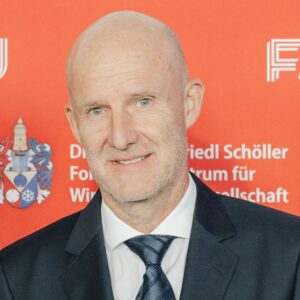
Prof. Dr. Johann Füller is Professor of Innovation and Entrepreneurship at the University of Innsbruck. Previously, he served as a Fellow at the NASA Tournament Lab-Research at Harvard University and as a Visiting Scholar and Research Affiliate at the MIT Sloan School of Management. His research focuses on artificial intelligence, innovation management, co-creation, business incubation, and sustainability. His work is widely published in leading academic journals, including California Management Review, Information Systems Research, Journal of Management Information Systems, Marketing Science, MIS Quarterly, and Research Policy.A strong advocate for bridging academia and industry, he co-founded HYVE AG, an innovation agency he led as CEO for over 20 years.
The Rise of Agentic AI: Redefining Consumer Autonomy and Market Dynamics
As AI agents evolve from passive tools into autonomous decision partners, they fundamentally reshape the consumer journey. This project explores the transition toward Agentic AI, where algorithms act as proxies, co-deciders, and market gatekeepers. The research project investigates how this hybrid architecture impacts consumer autonomy, trust, and decision quality. Beyond the individual, the research models how AI agents steer innovation diffusion and alter market competition. By bridging consumer psychology and systems theory, the research project develops essential frameworks for digital responsibility and governance to ensure fairness in an era of automated agency.

Prof. Shirley Gregor, PhD is Professor of Information Systems at the Australian National University, Canberra, where she is a Director of the National Centre for Information Systems Research. Shirley Gregor’s research interests include the adoption and strategic use of information and communications technologies, intelligent systems, human-computer interaction and the philosophy of technology. Dr Gregor has published in journals such as MIS Quarterly, Journal of the Association of Information Systems, European Journal of Information Systems and Information Technology & People. Professor Gregor was made an Officer of the Order of Australia in June 2005 for services as an educator and researcher in the field of information systems and for work in e-commerce in the agribusiness sector. She is a Fellow of the Australian Computer Society and a Fellow of the Association for Information Systems.
Knowledge-Design-Innovation (KDI) Research Program
Shirley Gregor and Alan R. Hevner work on a collaborative project with the goal of integrating research streams in the areas of knowledge, design, and innovation (KDI). They are currently working on a unifying framework for investigating and managing innovation. Drawing on their widely-cited publications on design science research methods, they propose a new framework for understanding innovation, the Knowledge Innovation Matrix (KIM). This framework is based on the two dimensions of knowledge (solution) and application (problem) maturity. In an expansion of their earlier work, they plan an extensive literature review of processes, theories and outcomes that characterize innovation in each of the four KIM quadrants.
The overall aim of the KDI research program is to develop the Knowledge-Innovation Matrix (KIM) for use in managing innovation processes and outcomes and bridging boundaries between research disciplines and stakeholders in business, academia, and government. The next step envisaged for the research program is to develop a tool for managing innovation. Subsequent steps will investigate academic-industry collaboration in innovation and governance policies for assessing and encouraging innovation at global and national levels.

Prof. Alan R. Hevner, PhD is an Eminent Scholar and Professor in the Information Systems and Decision Sciences Department in the College of Business at the University of South Florida. He holds the Citigroup/Hidden River Chair of Distributed Technology. Dr. Hevner’s areas of research interest include information systems development, software engineering, distributed database systems, healthcare systems, and service-oriented computing. He has published over 200 research papers on these topics and has consulted for a number of Fortune 500 companies. Dr. Hevner received a PhD in Computer Science from Purdue University. He has held faculty positions at the University of Maryland and the University of Minnesota. Alan R. Hevner is a Fellow of the American Association for the Advancement of Science (AAAS) and is a member of the Association for Information Systems (AIS), the Association for Computing Machinery (ACM), the Institute of Electrical and Electronics Engineers (IEEE), and Information Systems Research (INFORMS).
Knowledge-Design-Innovation (KDI) Research Program
Alan R. Hevner and Shirley Gregor work on a collaborative project with the goal of integrating research streams in the areas of knowledge, design, and innovation (KDI). They are currently working on a unifying framework for investigating and managing innovation. Drawing on their widely-cited publications on design science research methods, they propose a new framework for understanding innovation, the Knowledge Innovation Matrix (KIM). This framework is based on the two dimensions of knowledge (solution) and application (problem) maturity. In an expansion of their earlier work, they plan an extensive literature review of processes, theories and outcomes that characterize innovation in each of the four KIM quadrants.
The overall aim of the KDI research program is to develop the Knowledge-Innovation Matrix (KIM) for use in managing innovation processes and outcomes and bridging boundaries between research disciplines and stakeholders in business, academia, and government. The next step envisaged for the research program is to develop a tool for managing innovation. Subsequent steps will investigate academic-industry collaboration in innovation and governance policies for assessing and encouraging innovation at global and national levels.

Prof. Ian P. King, PhD completed his PhD in Economics at Queens University (Canada), in 1989. He held positions at the University of Calgary and the University of Victoria (Canada), the University of Iowa (USA), the University of Auckland and University of Otago (New Zealand) and at the University of Melbourne (Australia). Currently, he is Professor of Macroeconomics at the University of Queensland (Australia). He is published in top journals such as Econometrica, the Review of Economic Studies, the Journal of Monetary Economics, and the Journal of Economic Theory. He was editor of the New Zealand Economic Papers and is currently the Chair of Board of the Australasian Macroeconomics Society.
Income Inequality, Unemployment, and Public Policy
The project studies how income inequality and unemployment are jointly determined, the effects of public policies on both, and will identify optimal policy settings. A quantitative model will be built where workers have different skills and firms create both high and low quality jobs. Policy variables such as unemployment benefits, job subsidies, and an income tax structure, with a government budget constraint, will be introduced to examine the influences of each of these variables, and how they can be harmonized. The funds will mostly be used as part of a graduate-level student exchange program, to foster collaborative research among German and Australian macroeconomists on this topic.

Prof. Dr. Jan Marco Leimeister is Chair of Information Systems and Managing Director of the Institute for Information Systems (IWI-HSG) at the University of St. Gallen (Switzerland). He works on topics related to digital transformation, digital service innovation, crowdsourcing as well as the future of digital collaboration, digital learning, and the interaction between artificial intelligence and humans. He has received international awards for outstanding research, teaching and education. Since 2009, he has consistently ranked among the top 1 % of the most productive researchers in the field of business administration in German-speaking countries. His work is regularly published in A+ and Financial Times Top 50 journals. He is Editor in Chief of the Journal of Information Technology (JIT) and serves on the editorial boards of Information Systems Research (ISR) and Journal of Management Information Systems (JMIS), among others. He is Director of the Scientific Center for Information Technology Design (ITeG) at the University of Kassel. He is also Vice President of the Association for Information Systems (AIS).
GenAi and Knowledge Work – Is It Possible to Shape Your Own Work in a Self-Determined Way When Using GenAi?
The age of generative artificial intelligence (AI) is changing the way we learn, live, and work. Employees have great potential to simplify and change their tasks if they are motivated and empowered to do so. In occupational psychology, this phenomenon is known as “job crafting”. The research project is dedicated to an in-depth analysis of how the use of generative AI tools influences work behavior. This includes in particular the effects on productivity as well as on the development of employees’ skills. The possible cognitive relief through the use of generative AI is of particular importance. For this, the project is also using neurophysiological measurement methods to gain insights into cognitive processing during the use of AI. The aim is to develop a comprehensive understanding of how generative AI technologies can not only change the world of work, but also enrich it. The expected results promise to make a stimulating contribution to the current debate on the influence and integration of generative AI in the world of work.

Prof. Andy Neely, PhD Andy Neely is Founding Director of the Cambridge Service Alliance and the Royal Academy of Engineering Professor of Complex Services at the University of Cambridge. He is widely recognized for his work on the servitization of manufacturing and strategic performance measurement. Previously he has held appointments at Cranfield University, London Business School, Nottingham University, where he completed his PhD and British Aerospace. He was Deputy Director of AIM Research – the UK’s management research initiative – from 2003 until 2012 and was elected a Fellow of the British Academy of Management in 2007, an Academician of the Academy of Social Sciences in 2008 and a Fellow of the European Operations Management Association in 2009.
Service Business Model Innovation: The Impact of “Big Data”
Much of the discussion about big data focuses on customer analytics, yet there is increasing evidence that big data can be used in business model innovation. Leading firms are already experimenting with how new sources of data might enable them to create new value for customers, supported by innovative service business models. In this project we will: (i) explore the scope and potential for big data to stimulate business model innovation in manufacturing firms making the shift to services; (ii) identify the practical and theoretical challenges in making better use of big data for business model innovation; and (iii) develop and test a methodology that can be used to stimulate creative thinking about the scope for new business models drawing on big data.

Prof. Jeffrey Parsons, PhD is University Research Professor and Professor of Information Systems in the Faculty of Business Administration at Memorial University of Newfoundland. His research interests include conceptual modeling, crowdsourcing, information quality, data integration, and recommender systems. His work on these topics has appeared in top journals in information systems (e.g., MIS Quarterly, Information Systems Research, Journal of the Association for Information Systems), management (e.g., Management Science), computer science (e.g., ACM Transactions on Database Systems, IEEE Transactions on Knowledge and Data Engineering), and biology (e.g., Nature, Conservation Biology). He is a Senior Editor for MIS Quarterly, a former Senior Editor for the Journal of the Association for Information Systems, and he has served as Program Co-chair for a number of major information systems conferences, including AMCIS, WITS, and ER.
Designing Data Crowdsourcing Platforms to Increase Data Quality
Crowdsourcing is a popular way to engage people in data collection. A key challenge in crowdsourcing is ensuring that data are diverse enough to support unanticipated uses. This research is comprised of two parts. First, experimental studies will be conducted to test hypotheses that contributor expertise is negatively associated with data diversity, but unrelated to data accuracy. Second, based on these studies the research will propose and evaluate design features aimed at increasing the diversity of crowdsourced data. The results of this research will contribute to our understanding of how to design crowdsourcing platforms to maximize the ability to capture high quality, diverse data.

Prof. Rasul, PhD is Professor at the University College London, co-director of the Centre for the Microeconomic Analysis of Public Policy at the Institute of Fiscal Studies, and research co-director of the Entrepreneurship Research Program of the International Growth Centre. He obtained his PhD in Economics from the London School of Economics in 2003. His research interests include labor, development and public economics. From 2009 to 2013, he was a managing editor of the Review of Economic Studies journal. He was awarded the 2007 IZA Young Economist Prize and the 2008 CESIfo Distinguished Affiliate Award.
Understanding Illicit Behaviour
The research project analyses the causes of illicit behaviour in multiple studies. In a first project, the determinants of tax compliance in settings where individuals tax themselves by self-assessing their taxable income will be identified. In a second project, the causes of criminal behaviour and how they interlink with policing strategies related to the drug market will be investigated.

Prof. Carol S. Saunders, PhD is Professor Emeritus at the University of Central Florida. She is a LEO award winner for lifetime accomplishments to the IS discipline and an Association of Information Systems Fellow. She served on a number of editorial boards, including a three-year term as Editor-in-Chief of MIS Quarterly. She also served as General Conference Chair of a premier Information Systems (IS) conference, ICIS. Her outstanding research status is reflected in over 50 publications in top-ranked Information Systems, Computer Science, Management and Communications journals. She held a Distinguished Fulbright Scholar Chair at the Wirtschaftsuniversität Wien (WU) and further research chairs in New Zealand, Singapore, and the Netherlands. In 2012, she was guest professor at the Institute of Information Systems at FAU Erlangen-Nürnberg.
Understanding Information Overload
Using the Emotional-Cognitive Model (ECM) of overload the cognitive processing of stimuli created by new information or requests to adopt new technologies will be studied. ECM suggests that individuals’ cognitive systems differentially handle load as a function of cognitive and emotional schemata encoded in memory. Consequently, not everyone experiences overload in the same way – if at all. ECM may help explain the sometimes overwhelming cognitive and emotional consequences of dealing with information stimuli and requests to use new Information Technologies in today’s digital world.

Prof. Dr. Martin Schreier is Professor of Marketing at WU Vienna. Before joining WU, he was a tenured faculty member of the marketing department at Bocconi University, Milan (Italy). His teaching and research interests are anchored in core topics of marketing, including product and brand management, creativity and new product development, and consumer behavior.
His work has been published in premier journals such as the Journal of Marketing or Management Science, awarded with several best paper awards, and featured in international media outlets. He currently serves as an Associate Editor at the Journal of Marketing and is the Editor-in-Chief Elect of the International Journal of Research in Marketing.
University Knowledge Inside: How and When University-Industry Collaborations Make New Products More Attractive to Consumers
Firms increasingly collaborate with universities to find innovation success. This research project is the first to investigate how consumers perceive university-co-developed products. Initial evidence suggests a positive inferential process such that consumers experience products co-developed with a university to be more sophisticated and trustworthy compared to firm-internally developed products or products co-developed with merely another firm. Consequently, consumers might be more eager to purchase such products.
This research aims to advance our understanding of university-industry collaborations by showing how and when involving universities as an innovation partner might be beneficial for marketing purposes.

Prof. Dr. Jan vom Brocke is Chair of Information Systems & Business Process Management at the University of Münster and a Director of ERCIS – The European Research Center for Information Systems. His work has been published in many of the A+ and Financial Times Top 50 ranked journals, among others in Management Science, MIS Quarterly, JMIS, and MIT Sloan Management Review. He has served in many senior academic roles, including as VP Research of the University of Liechtenstein, VP Education of the Association for Information Systems (AIS) and VP Technology of the German Association for Business Research (VHB). In recognition of his work, he has been named a Fellow of the AIS.
Process Science – The Interdisciplinary Study of Continuous Change
This research project studies the understanding of continuous change. We live in an age of change, such as climate change, globalization, the platformization, or societal movements. Yet, we struggle to understand or even influence change. Process science is a new interdisciplinary field that builds on the computation of rich digital trace data, such as sensor and social media data to identify change (descriptive process science); it analyses such data in a rich empirical context to better understand change (explanatory process science), and it also develops innovative solutions to influence change for the benefit of economy and society (prescriptive process science).

Prof. Richard Watson, PhD is a Regents Professor Emeritus of the University of Georgia. He is a former President of the Association for Information Systems and was awarded its highest honor for his achievements in information systems (AIS Fellow). He was a visiting researcher at the Research Institutes of Sweden for about a decade. In 2021, the University of Liechtenstein awarded him an honorary doctorate. Professor Watson has published over 200 journal articles and written books on electronic commerce, data management, and energy informatics. His most recent book is Capital, Systems, and Objects. He recently accepted a partial appointment as Research Director with an Australian consulting firm.
Thermal Comfort as a Service
About 40% of all the energy consumed by buildings is used to provide thermal comfort to the occupants. However, sometimes rooms are heated when there unoccupied, or they are already warm enough, and vice versa for cooling. Thermal comfort is a range, not a fixed point. It can be managed across many rooms to minimize the cost of electricity while meeting occupants’ needs. Minimizing daily electricity costs requires sensitizing rooms to measure their thermal characteristics, determining their current and future occupancy, and predicting future electricity prices. We will prototype a system to manage thermal comfort as an energy company service.

Prof. Nilmini Wickramasinghe PhD is Professor and Optus Chair Digital Health at La Trobe University. She is also an honorary research professor at the Peter MacCallum Cancer Centre. Her research focuses on the design, development and application of Information Communication Technologies (ICTs) to effect superior, patient centric healthcare delivery. She collaborates with leading scholars at various premier healthcare organizations throughout Australasia, the US and Europe. She is well published with more than 300 referred scholarly articles, more than 10 books, numerous book chapters, an encyclopaedia, and a well established funded research track record.
An Investigation Into the Role for Pervasive Technologies to Support Superior Healthcare Delivery
The goal of this proposed study is to focus on how mobile applications and emerging technologies can be utilized to address the challenges faced by healthcare such as escalating cost pressures, an increasing aging population, an increasing prevalence of chronic diseases, and a move to a preventive care focus. Integral to these solutions is a patient-centric view in order to satisfy consumer expectations and provide high quality care. Specifically, the aim is to assess the usability, acceptability and functionality of a pervasive technology solution for patients including; patient compliance, patient and professional satisfaction and accuracy/benefits over standard care choices.